Last month I spent six hours reviewing 150 resumes for a single position. I made a spreadsheet. I ranked people. I second-guessed myself constantly. By the end, I wasn’t confident I’d surfaced the best candidates — I was just exhausted.
That weekend, I started building something to fix it.

The Problem Nobody Talks About
If you’ve ever hired someone, you know the pain. Resumes pile up. You skim the first page, maybe the second. You ctrl+F for keywords. You miss good people because their formatting was weird or they buried the relevant experience on page two.
Enterprise tools exist, but they want $200+/month and a sales call. Most small teams don’t hire constantly — we hire in bursts, then not again for months. Paying a subscription for something you use twice a year doesn’t make sense.
And the keyword-matching approach that most applicant tracking systems use? It’s broken. Someone can stuff their resume with the right words and rank higher than a candidate who actually did the work but described it differently.
I wanted something smarter. Something that reads like a human reads — looking for evidence, not just keywords.
What I Built
StrixScreener does one thing: it screens resumes and tells you who to interview first.
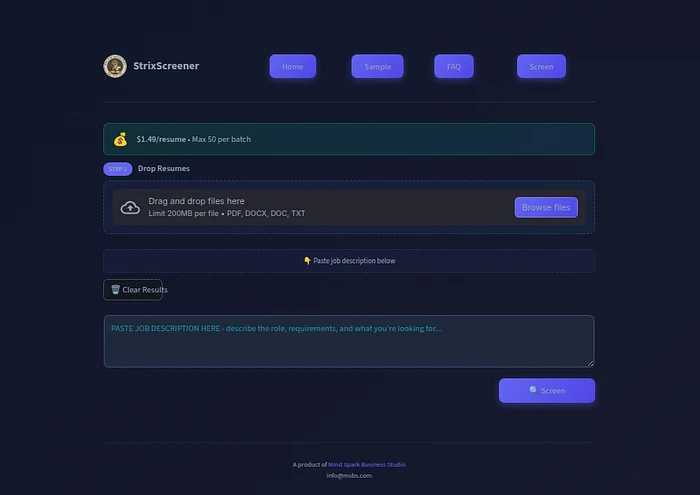
You upload a batch of resumes (up to 50), give it a job description or pick from preset roles, and it runs a two-pass analysis:
- First pass: Quick evaluation of skills, experience, and fit
- Second pass: Deeper look at top candidates — verifying claims, checking for evidence, generating interview questions
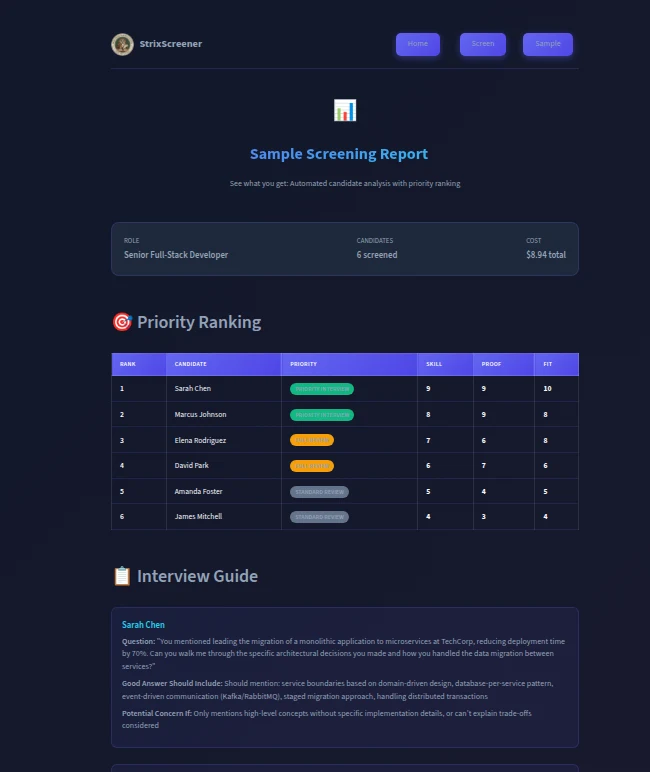
The output is a priority ranking: — Priority Interview — strong match, schedule them — Full Review — worth a closer look
— Standard Review — keep on file, but not urgent
Each candidate gets a score breakdown (skill, authenticity, fit) and a suggested interview question with notes on what a good answer should include.
No “REJECT” labels. Everyone stays in the pool at different priority levels — because sometimes your first choice declines and you need to go back to the list.
Why $1.49 Per Resume Pricing card
I thought hard about pricing. Subscriptions are the default for SaaS, but they don’t fit this use case.
Small teams don’t hire every month. Recruiters work on variable deal flow. Agencies bill per placement anyway.
So I went with pay-per-use: $1.49 per resume screened.
No monthly fee. No commitment. Screen 10 resumes for a quick hire, pay $15. Screen 200 for a big search, pay $300. Don’t hire for six months, pay nothing.
It’s less than what you’d spend on coffee during a manual screening session.
What I Learned Building This
People want the interview questions as much as the ranking. I added those after the first few users asked. Now it’s one of the main features — each candidate comes with a targeted question designed to verify their claimed experience.
Evidence beats keywords. The system looks for measurable outcomes, specific project descriptions, concrete details. “Managed cloud infrastructure” scores lower than “Migrated 200 servers to AWS, reducing monthly costs by 40%.” That’s how humans evaluate resumes anyway — they’re just too tired to do it consistently across 150 candidates.
HR-safe language matters. Early versions had “REJECT” as a category. Feedback was immediate: nobody wants that word on a report that might end up in a file somewhere. Now it’s “Standard Review” — same meaning, no liability.
The Numbers
- 150 resumes manually: 6 hours of your life
- 150 resumes with StrixScreener: ~2.5 hours, ranked and ready
- Cost: Less than lunch
- What you get back: Your sanity, and confidence you didn’t miss someone good
Already being evaluated by enterprise teams. Built to solve my problem — turns out it solves yours too.
Try It Now
You’ve got a stack of resumes sitting in your inbox right now.
Upload them. Get your ranked list before lunch.
$1.49/resume. No subscription. Results in minutes.
Got feedback? I’m still iterating. This thing exists because I needed it — and I’m betting you do too.
^(Built on a Halo Strix workstation. Deployed for the cost of lunch. Solving a problem I was tired of having.)
^(Tech details for the curious: Streamlit frontend, Claude API for analysis, Stripe for payments, AWS App Runner for hosting. Total infrastructure cost: ~$15/month.)